Saturday, April 9, 2011

Nak Cari Kawan Senang, Nak Cari SAHABAT??Cukup susah!


Syarat2 bersahabat dan inilah ciri2 sahabat :

1. Kalau mereka susah, memerlukan bantuan, kenalah kita bantu sama ada dengan wang ringgit, tenaga mahupun nasihat dan pandangan kita.

2. Kalau mereka meminta sesuatu, kenalah kita beri. Jika kita tidak mampu, minta maaflah kepadanya.

3. Kenalah ziarah selalu dan lihat-lihatlah apakah yang perlu kita bantu.

4. Sewaktu ke rumahnya, bawalah buah tangan.

5. Berilah hadiah terutama di waktu-waktu yang sesuai seperti mereka mendapat anak, waktu perkahwinan dan sebagainya.

6. Di waktu sakitnya kenalah ziarah dan doakan kesembuhannya.

7. Di waktu mereka mendapat sesuatu yang menggembirakan, hendaklah kita juga lahirkan kegembiraan.

8. Di waktu mereka mendapat sesuatu kesusahan dan kesedihan, hendaklah kita juga melahirkan rasa kesedihan dan kesusahan sama.

9. Kebaikannya selalulah kita puji di belakangnya.

10. Kecacatan dan kekurangan atau keaibannya dan keluarganya, hendaklah kita tutup. Ertinya kita jangan mengumpatnya.

11. Kalau ada orang lain mengumpatnya di hadapan kita, kenalah nasihat orang itu atau kita tinggalkan majlis itu.

12. Kalau dia mengajak kita menemaninya ke mana-mana, kenalah kita menerimanya kecuali kalau ada keuzuran yang tidak dapat dielakkan.

13. Kalau dia menjemput ke majlis, wajib kita menerima jemputannya.

14. Kenalah ziarah serta mengambil perhatian keluarganya selepas matinya.

15. Kenalah ziarah sahabat baiknya. Kalau boleh mengambil perhatian kehidupan keluarga mereka selepas matinya.

16. Selalu mendoakannya di luar pengetahuannya atau bukan di majlisnya.

17. Berilah kemaafan di atas kesalahan terhadap kita.

18. Mintalah maaf kepadanya di atas kesalahan dan kekurangan dan kelemahan diri dalam menunaikan tanggungjawab terhadapnya.

Oleh itu, bersahabat besar ertinya. Kerana itulah Rasulullah SAW memanggil pengikut-pengikutnya dengan perkataan Sahabat. 
Tetapi erti sahabat lebih mendalam dan mesra.

Erti sahabat, orang yang sentiasa mengiringi kita, sentiasa ada di samping kita atau selalu berdekatan dengan kita. Erti mengiring atau sentiasa di samping atau berdekatan dengan kita itu, bukan erti luaran sahaja. Bukan sekadar lahiriah sahaja tetapi batinnya sekali. Seperti mengiringi dan mendampingi hati kita. Dekat dengan hati kita. Dengan kata yang lain, seseorang sahabat itu sentiasa memerhati dan memikirkan kehidupan lahir sahabatnya seperti makan minum, pakaian, tempat tinggal, situasi tempat tinggal, sakit pening, susah payah dan pendidikannya.

Ini Satu PENIPUAN !!


Sy nak kongsi la ckit cerita ni ngan pembaca2 semua(cey,pembaca2 konon). I hope you guys bley amik pngajaran dr ape yg sy nak story ni. Baru2 ni ada satu PRIVATE NUMBER ni call no phone sy, pastu cakap dia dari CELCOM. Start dari conversation di sini sy mula meragui sesuatu.
Kenapa??
Satu makhluk ni cakapla “Selamat Pagi, sy dari celcom, semalam kami ada buat satu undian ya dan hasilnya no telefon encik telah menang cabutan bertuah sebanyak RM5000”.
WOW!!
 No phone aku ni menang cabutan bertuah RM5000.

BIAR BETUL!!!!!
Ape yg aku ragui adalah kenapa org CELCOM ni bercakap berbau bahasa Indon??
pastu dia ckp “Kami tak mintak encik bg no ATM encik ya kerna itu privacy encik ya. Boleh saya tau encik pakai bank mana?”
Hati aku ni memang pantang org tipu aku bnda2 mcm ni. Tmbah2 bila tipu bodoh mcm ni.. DAhla kau tu bodoh, nak tipu aku mcm ni. Kau silap org la b**ch.
PERSOALANNYA knapa mesti operatornya communicate slank indon tak guna bahasa Melayu standard? Dan kenapa mesti PRIVATE NUMBER?
Hati aku mengelegak.. GLUP GLUP GLUP drahku mendidih. Boiling Point la katekan.
Aku dah xtahan nk dgr lg soalan dia nk tau bank yg aku berurusan. Aku tnya “Jap, knapa CELCOM pakai PRIVATE NUMBER ek?”..dia jwb “Kami tak nak bla3……”..alasan tak logic lansung.
Aku dah bosan dgr alasan pompuan tu. Aku terus jer ckap “Oww,kalau mcm tu sy xnak la menang,dan tlg sedekahkan jela hadiah duit yg sy menang tu kat org yg xmampu”…dia jwb lg “xpe jela”…n tut tut tut..
LETAK PHONE CAMTU JER!!!!!
KUrang ajor betul!!
…aku tau tu bkn org Celcom..Kalau org celcom confirm2 diorang bercakap ikut procedure dan ber adab..yg td tu bkn beradab tp BIADAP..So Please don’t be fooled by this makhluk2 yg tiada tamadun ni..hopefully korang terselamat dan terhindar dr perkara ni berlaku kat org lain.

Friday, February 25, 2011

Dop Pahang Aku Org Gni..


Tak faham aku dengan sesetengah golongan tu.
Sen takde tp berlagak.
Hidup nak loaded & nak senang jer.
Duit takde tapi benda2 remeh yang bleh buat sndri tak nak buat pulak, nk anta kedai jer..
pastu duit abes mntak pnjam dengan kawan..
Mamber pun takde duit jugak sama macam orang lain tapi pandai2 la jaga kewangan masing2..
mentang2 la nmpak member ada duit dalam bank..aduyai..i hate this type..
Walaupun agama penuh didada tapi tak kemana kalau asyik menyusahkan orang lain walhal benda macam ni dapat dia sendiri elak. 
Ape itu neraka (what the hell!).

Thursday, January 27, 2011

Turbine..from NASA


Jet engines move the airplane forward with a great force that is produced by a tremendous thrust and causes the plane to fly very fast.

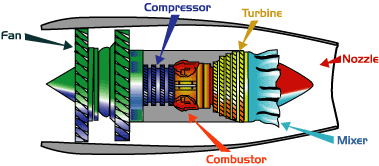
All jet engines, which are also called gas turbines, work on the same principle. The engine sucks air in at the front with a fan. A compressor raises the pressure of the air. The compressor is made up of fans with many blades and attached to a shaft. The blades compress the air. The compressed air is then sprayed with fuel and an electric spark lights the mixture. The burning gases expand and blast out through the nozzle, at the back of the engine. As the jets of gas shoot backward, the engine and the aircraft are thrust forward.

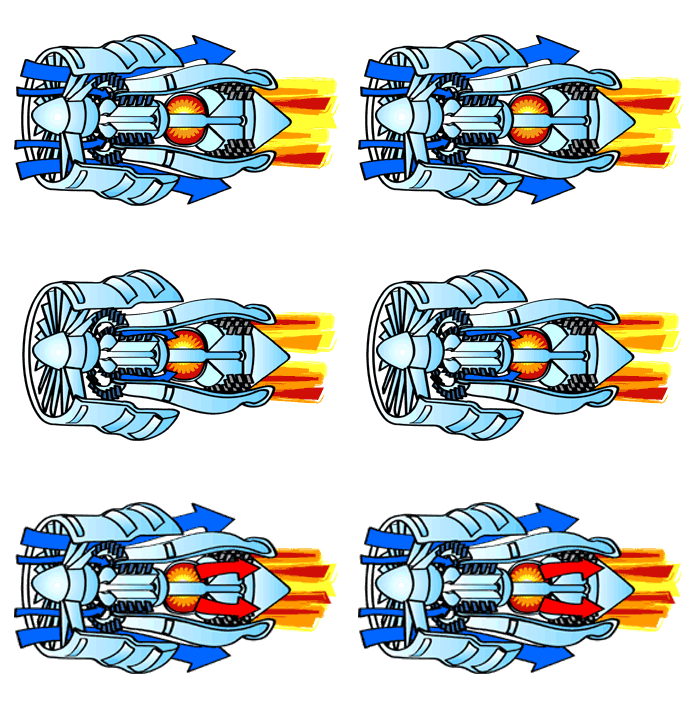
The image below shows how the air flows through the engine. The air goes through the core of the engine as well as around the core. This causes some of the air to be very hot and some to be cooler. The cooler air then mixes with the hot air at the engine exit area.


This is a picture of how the air flows through an engine


What is Thrust?
Thrust is the forward force that pushes the engine and, therefore, the airplane forward. Sir Isaac Newton discovered that for "every action there is an equal and opposite reaction." An engine uses this principle. The engine takes in a large volume of air. The air is heated and compressed and slowed down. The air is forced through many spinning blades. By mixing this air with jet fuel, the temperature of the air can be as high as three thousand degrees. The power of the air is used to turn the turbine. Finally, when the air leaves, it pushes backward out of the engine. This causes the plane to move forward.


Parts of a Jet Engine


Fan - The fan is the first component in a turbofan. The large spinning fan sucks in large quantities of air. Most blades of the fan are made of titanium. It then speeds this air up and splits it into two parts. One part continues through the "core" or center of the engine, where it is acted upon by the other engine components.
The second part "bypasses" the core of the engine. It goes through a duct that surrounds the core to the back of the engine where it produces much of the force that propels the airplane forward. This cooler air helps to quiet the engine as well as adding thrust to the engine.

Compressor - The compressor is the first component in the engine core. The compressor is made up of fans with many blades and attached to a shaft. The compressor squeezes the air that enters it into progressively smaller areas, resulting in an increase in the air pressure. This results in an increase in the energy potential of the air. The squashed air is forced into the combustion chamber.

Combustor - In the combustor the air is mixed with fuel and then ignited. There are as many as 20 nozzles to spray fuel into the airstream. The mixture of air and fuel catches fire. This provides a high temperature, high-energy airflow. The fuel burns with the oxygen in the compressed air, producing hot expanding gases. The inside of the combustor is often made of ceramic materials to provide a heat-resistant chamber. The heat can reach 2700°.

Turbine - The high-energy airflow coming out of the combustor goes into the turbine, causing the turbine blades to rotate. The turbines are linked by a shaft to turn the blades in the compressor and to spin the intake fan at the front. This rotation takes some energy from the high-energy flow that is used to drive the fan and the compressor. The gases produced in the combustion chamber move through the turbine and spin its blades. The turbines of the jet spin around thousands of times. They are fixed on shafts which have several sets of ball-bearing in between them.

Nozzle - The nozzle is the exhaust duct of the engine. This is the engine part which actually produces the thrust for the plane. The energy depleted airflow that passed the turbine, in addition to the colder air that bypassed the engine core, produces a force when exiting the nozzle that acts to propel the engine, and therefore the airplane, forward. The combination of the hot air and cold air are expelled and produce an exhaust, which causes a forward thrust. The nozzle may be preceded by a mixer, which combines the high temperature air coming from the engine core with the lower temperature air that was bypassed in the fan. The mixer helps to make the engine quieter.

Types of Jet Engines


Turbojets

The basic idea of the turbojet engine is simple. Air taken in from an opening in the front of the engine is compressed to 3 to 12 times its original pressure in compressor. Fuel is added to the air and burned in a combustion chamber to raise the temperature of the fluid mixture to about 1,100°F to 1,300° F. The resulting hot air is passed through a turbine, which drives the compressor. If the turbine and compressor are efficient, the pressure at the turbine discharge will be nearly twice the atmospheric pressure, and this excess pressure is sent to the nozzle to produce a high-velocity stream of gas which produces a thrust. Substantial increases in thrust can be obtained by employing an afterburner. It is a second combustion chamber positioned after the turbine and before the nozzle. The afterburner increases the temperature of the gas ahead of the nozzle. The result of this increase in temperature is an increase of about 40 percent in thrust at takeoff and a much larger percentage at high speeds once the plane is in the air.
The turbojet engine is a reaction engine. In a reaction engine, expanding gases push hard against the front of the engine. The turbojet sucks in air and compresses or squeezes it. The gases flow through the turbine and make it spin. These gases bounce back and shoot out of the rear of the exhaust, pushing the plane forward.

Picture of Turbojet Engine


Turboprops

A turboprop engine is a jet engine attached to a propeller. The turbine at the back is turned by the hot gases, and this turns a shaft that drives the propeller. Some small airliners and transport aircraft are powered by turboprops.
Like the turbojet, the turboprop engine consists of a compressor, combustion chamber, and turbine, the air and gas pressure is used to run the turbine, which then creates power to drive the compressor. Compared with a turbojet engine, the turboprop has better propulsion efficiency at flight speeds below about 500 miles per hour. Modern turboprop engines are equipped with propellers that have a smaller diameter but a larger number of blades for efficient operation at much higher flight speeds. To accommodate the higher flight speeds, the blades are scimitar-shaped with swept-back leading edges at the blade tips. Engines featuring such propellers are called propfans.

Picture of turboprop engine


Turbofans

A turbofan engine has a large fan at the front, which sucks in air. Most of the air flows around the outside of the engine, making it quieter and giving more thrust at low speeds. Most of today's airliners are powered by turbofans. In a turbojet all the air entering the intake passes through the gas generator, which is composed of the compressor, combustion chamber, and turbine. In a turbofan engine only a portion of the incoming air goes into the combustion chamber. The remainder passes through a fan, or low-pressure compressor, and is ejected directly as a "cold" jet or mixed with the gas-generator exhaust to produce a "hot" jet. The objective of this sort of bypass system is to increase thrust without increasing fuel consumption. It achieves this by increasing the total air-mass flow and reducing the velocity within the same total energy supply.


Picture of Turbofan Engine


Turboshafts

This is another form of gas-turbine engine that operates much like a turboprop system. It does not drive a propeller. Instead, it provides power for a helicopter rotor. The turboshaft engine is designed so that the speed of the helicopter rotor is independent of the rotating speed of the gas generator. This permits the rotor speed to be kept constant even when the speed of the generator is varied to modulate the amount of power produced.


Picture of Turboshaft Engine


Ramjets

The most simple jet engine has no moving parts. The speed of the jet "rams" or forces air into the engine. It is essentially a turbojet in
which rotating machinery has been omitted. Its application is restricted by the fact that its compression ratio depends wholly on forward speed. The ramjet develops no static thrust and very little thrust in general below the speed of sound. As a consequence, a ramjet vehicle requires some form of assisted takeoff, such as another aircraft. It has been used primarily in guided-missile systems. Space vehicles use this type of jet.


Picture of Ramjet Engine